


At the very end of my sister’s life, I sometimes sat in the chair next to her bed and watched her sleep. In those paper-thin hours, I’d try to airlift myself to the place I knew was coming – my life with her gone. Maybe I could get ready for it.
My guess was that the high-wire, hyper-competence I’d onboarded for the two plus years of her dying would finally buckle. This would be due to what everyone called ‘grief’. I pictured Netflix, meds, depression, sleep, therapy, skipping therapy and uncontrollable crying.
But none of those ended up being very accurate. I had a couple of crazy crying jags. Sure. But only a few. My immediate reaction tracked much more closely with what one might call a post-traumatic-stress response than it did to what we typically think of as grief or deep sadness.
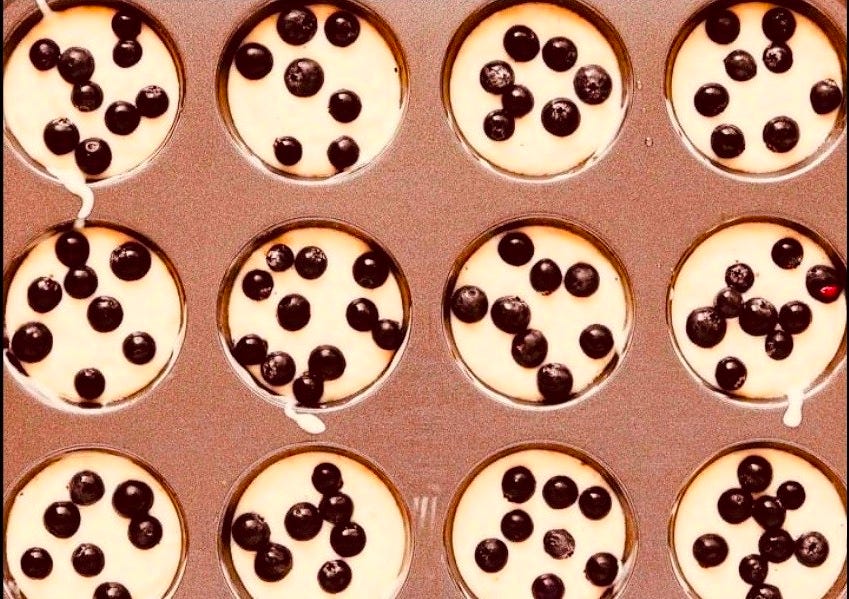
The last thing I would have expected to be a solace in that dumbstruck wilderness: baking. But baking and cooking seemed eminently sane to me in my addled, amped-up state, the recipes like friends.
Death Was Trending
This was me then: when I left my safehouse (the kitchen), I’d be walking past a couple arguing in the street and feel sure one of them would end up dead. At the Gristedes, I’d note impassively the Post’s headline - Massive Earthquake! Hundreds suspected dead! And think to myself: Of course. They’re all dying. They’re buried alive. They can’t breathe... Then, I’d take my change wordlessly from the cashier and walk out the sliding glass doors onto Broadway, scanning the buildings for which one was mine. And remember: Oh, that’s right. I live on West End.
You can’t airlift yourself to this place. You’re dropped there without a clue.
The unexpected consolation I found back in my kitchen was partially due to the fact it was brand new. In what I initially assumed was a twist of very unfortunate timing, a long-planned renovation to our apartment ended up happening the very year my mom and sister died. So it was, that I went directly from my sister’s graveside to my spanking new white kitchen with a marble backsplash.
Of course, I could protest that this was wildly disconsonant to me. That I was way too bereft to even notice that all the appliances were better and bigger, the paint clean and fresh, every seam and corner of every counter and cabinet perfectly aligned. But that would be a lie.
It was, in fact, very reassuring — the space, the sheen, the view from the new windows. All of it felt ready and inviting and beautiful. It was not falling apart. Like my sister had.
And since I was certain I was losing my mind, this lovely place appeared to deflect suspicion. So, I stayed put there and cooled my heels in my exceedingly low-functioning state for the better part of a year.
Kitchen Counter > Life Raft
I produced rounds of chocolate almond muffins, batches of homemade yogurt, bone broths that simmered away, Bolognese with garlic bread, gingerbread with whipped cream. On and on it went. Anything that said steady, that said home, that said life. If I wasn’t slicing or dicing, I was grating or stirring or checking the oven or cleaning up for another round. For the next day. And the day after that.
I think I might have held out some hope that the aromas would rise up and reach Lis. Maybe they could summon her back. I could explain to her then that it wasn’t working. She’d appear at my front door with her open tote slung over her shoulder and that wide open smile, like a frontier. She’d be pulling an overnight bag behind her, because she planned to stay. In some way, all that cooking may have been a kind of séance.
But Lis never showed. And I kept cooking.
Elizabeth Eliot, twice a widow and an outsized figure in the 20th Century Christian world, spoke from personal experience about how one might survive and function when the mind and spirit are crushed. In the aftermath of her first husband’s murder, she came upon an obscure, 19th century poem, often cited as Ye Nexte Thynge.
Eliot was deeply moved by the poet’s hearkening to focus on the immediate, small, necessary next task. In it she found a ministry to the bereaved and would go on to speak and write about this simple idea for the rest of her life. It was a ready mantra we all knew:
Do-the-next-thing. Or sometimes you’d hear it: Do-the-next-right-thing.
Workshopping Elisabeth Eliot
I’d known about Eliot for years when my sister died, read her books, and knew of this oft-repeated watchword. But it never once occurred to me that what I’d done in my kitchen that year was to reverse engineer it. I’d unwittingly created a Do-the-next-thing atelier.
Almost a decade later and my heart hovers over those two words with an ache of recognition and gratitude: do and thing. They saved me. The marriage of movement and task: small, simple, sequential, success. (And by ‘success’ let’s keep our expectations modest. I mean: add an egg.)
A therapist might smartly suggest something more pointed: counseling, a grief group, medication. Yes. I did all that. Later. But I wasn’t capable of those things that first year. I was capable of muffins.
We know now that in trauma our left brain, in charge of higher order thinking and more complex reasoning, essentially goes off-line. It’s reduced to a low hum. What’s actually working in acute grief is your right brain: touch and feel, friendship and sunshine, fresh air and art, smell, taste, beauty and memory. A bike, a beach, a roller coaster, a scream.
I’ll say it straight, friends. After all my earnest studying, all the research and books and workshops and science, when this puzzle piece snapped into place, I was immediately returned to the smells and sounds of that kitchen. I found myself back at the beginning, kneading and whisking and rolling through the days.
We’re all the way back at banana bread.
I’m so curious. Please do tell if you’ve had you’re own Do-the-next-thing season. What task or activity did you do? I love hearing how different people make it through.
The File
Joan Didion- The Year of Magical Thinking
Grief turns out to be a place none of us know until we reach it. We anticipate (we know) that someone close to us could die, but we do not look beyond the few days or weeks that immediately follow such an imagined death. We misconstrue the nature of even those few days or weeks. We might expect if the death is sudden to feel shock. We do not expect this shock to be obliterative, dislocating to both body and mind. We might expect that we will be prostrate, inconsolable, crazy with loss. We do not expect to be literally crazy...
Trauma Brain Chart
Banana Bread recipe
Kitchen Dancing: Dire Straits, Skateaway
Kara, this was so heartbreaking beautiful. Thank you for sharing your story. This paragraph touched me so deeply in the best way:
"We know now that in trauma our left brain, in charge of higher order thinking and more complex reasoning, essentially goes off-line. It’s reduced to a low hum. What’s actually working in acute grief is your right brain: touch and feel, friendship and sunshine, fresh air and art, smell, taste, beauty and memory. A bike, a beach, a roller coaster, a scream."
So validating, and the perfect gentle permission to do just these things. I also love how you said you weren't ready for therapy that first year. You found what worked for you and what you were able to handle (the next best thing). 🤍🤍🤍
The kitchen becoming a kind of anchor, even a quiet lifeline, comes through clearly, especially tied to that “do the next thing” idea. It doesn’t try to resolve grief—it just shows how someone moves through it one small act at a time, and that makes it feel real. That line about being capable of muffins says a lot without trying to say everything. It connects with something I’ve been thinking about too—how in the middle of chaos, we’re often only given the next step, not the whole path. I wrote a short piece around that here: https://theeternalnowmm.substack.com/p/the-man-who-tried-to-surprise-god?r=71z4jh