


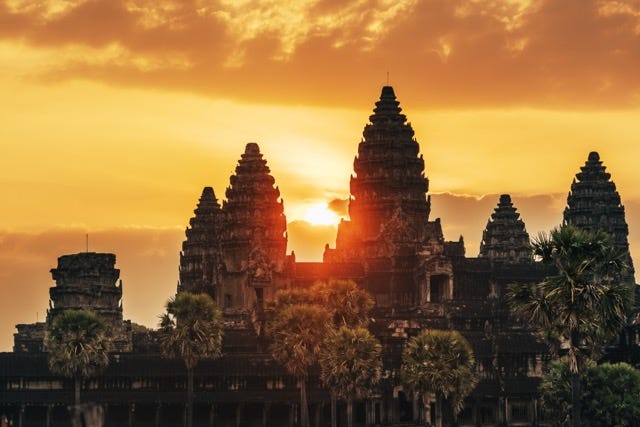
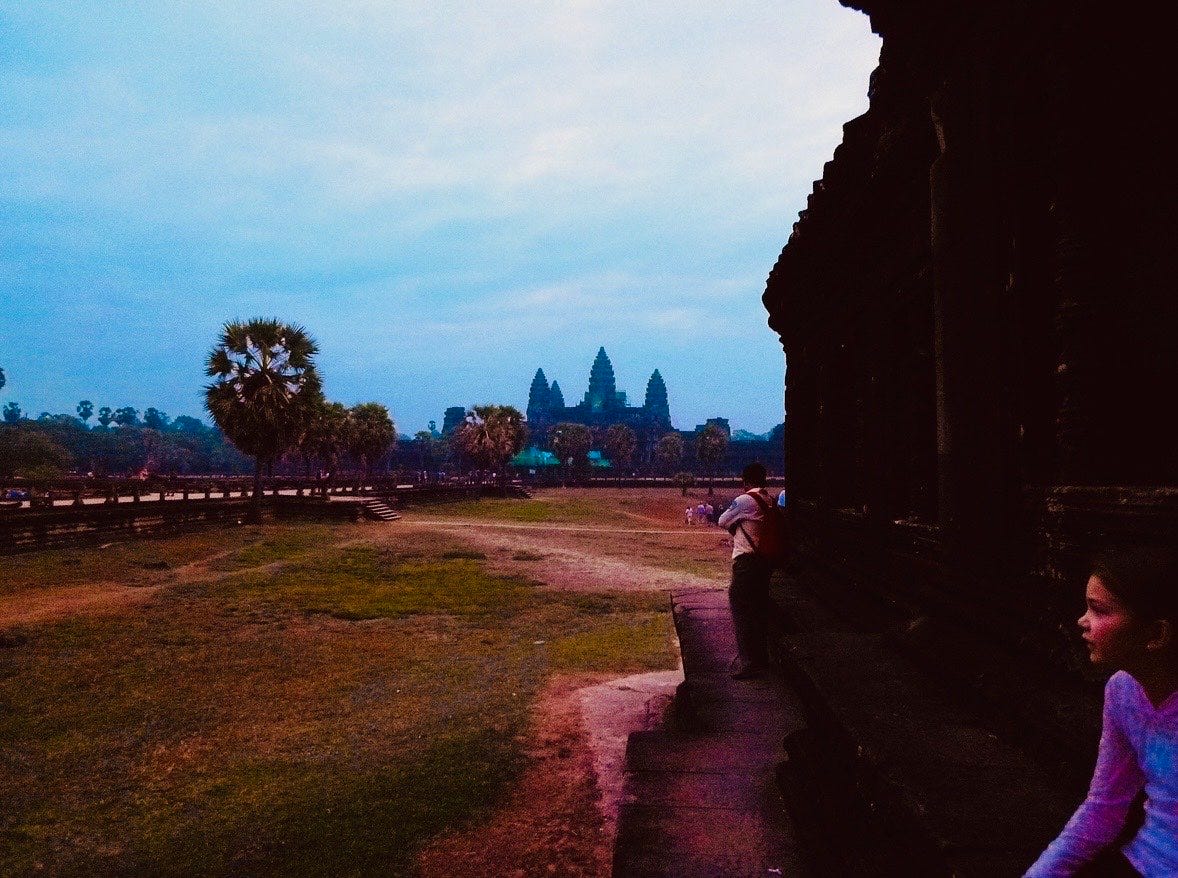
I met a man once in Cambodia. He was our driver, sent to take us to the ruins of a temple in the jungle outside Siem Reap. I immediately noticed his hands, his fingers were long and slender, elegant somehow. They reminded me of my father’s hands, who had died several years before. Perhaps that’s why I noticed them.
I followed his hands as he drove, working the wheel this way and that, something even and fluid in how he maneuvered the vehicle along the roadway, all its sudden holes, throngs of people and animals, the constant obstacles.
Donned in a perfectly crisp, pale green uniform, he carried himself with a gentle hesitation and seemed to have a settled embarrassment about the more direct parts of the job—money, tips, arrangements.
I noticed this even in the pre-dawn dark as we met and loaded into the vehicles, the smell of firewood and croissants mingling in the courtyard not far from the kitchen where the hotel owner’s French wife made morning pastry.
Once underway, the driver appeared glad to be absorbed in the day’s task, and I found him warm and his English excellent. There was a boyishness about him—his eyes bright white and dark brown and he had wonderfully thick black hair which swept across his forehead in a big, upturning wave.
We chatted easily for the whole first hour, mostly about the changes coming to his country. Eventually, I asked about his family.
He said he had none.
After a moment, he added that he’d survived the genocide alone.
Year Zero
This was December 1998. It had been my brother-in-law’s idea to add Cambodia to a tour around Southeast Asia that began in Hong Kong, where he and my sister, Jenny, then lived. I was in graduate school at the time.
The Khmer Rouge had only recently collapsed, and Cambodia was emerging from decades of political unrest and violence following the genocide. The country was not yet the popular tourist destination it would become.
Roads were cratered; many villages hollowed out. At night, I could hear the creak of bicycles in the dark.
It felt safe to be there but everywhere the air felt laden to me with the swallowed violence, caught in throats, choked back.
The prior thirty years felt compressed somehow, the history shorn and flattened, as if a tourniquet could hold the present to itself and nothing else.
I pictured the land also mute, but straining to give its testimony, to tell of all the bones it held, an omniscient witness to all that had happened there—a killing spree of the educated, the merchant class, the monks. All designed to return the country to some imagined, pre-modern peasant society Pol Pot called simply ‘Year Zero.’
The Driver
The driver’s face was so youthful, I’d misjudged his age by at least a decade. Quickly I scrambled the math in my head, sitting stunned next to him, as we pitched left to avoid a sinkhole and then glided to a stop at a makeshift intersection, still watching his hands. He took one off the wheel then to gesture the other vehicles to pass.
How he survived he didn’t say, and I didn’t ask.
A quiet followed his disclosure which he immediately seemed to claim and gently steward, navigating the exchange as he had the road, as if this were simply another gaping hole in another trackless stretch.
When the time he’d apportioned for his revelation and my shock had passed, he gathered his family back from the silence. In my mind’s eye, I almost pictured him laying a blanket over the words, covering them the way you might the dead.
The only detail he’d given was the order: they killed his mother first, then his siblings, and his father last. He told me this as mopeds rushed past, chickens flew by in baskets, and oxcarts kicked up dust.
He had a beautiful smile, as I remember—clear, inviolate. A part of him, like his hands. In Khmer you might say smoh trang—wholehearted.
Monsoons and Mystery
I wondered about him on my long journey home.
From my window seat I watched as the plane rose over the flat basin below—dark, rich soil, dotted with blocks and strips of green. Then jungle. Then mountains.
The agriculture there is fed by the Mekong, which swells during monsoon season, forcing its major tributary to reverse course and double in size, flooding everything.
In the months after the trip, my mind would wander often to the driver and how he’d survived, first ‘Year Zero’ and then everything else—his life.
Initially, my thoughts churned and ran restless. I wanted the buried details—how had it happened, how had he been saved or kept alive and by whom.
But the driver remained a mystery to me.
If I thought about him long enough, though, I’d return myself to the silence of the front seat that morning, waiting the beats out like he did, navigating them evenly, moving all the missing things through time.
The File
Cambodian Art and Artifacts: The MET Museum’s collection features examples of ancient Cambodian and Khmer Empire sculpture, dating from pre-Angkorean era through the 14th century. Another in a 1000 reasons to hit the MET this summer.
A Problem from Hell: America and the Age of Genocide by Samantha Powers. A well-researched book. Won the Pulitzer. It covers decades (and several different administrations of both parties) who did not do enough to stop mass murder.
William Sonoma Chocolate Croissants, arrive frozen and ready-to-bake. Yum.
Kitchen dancing - All These Things That I’ve Done, The Killers. (My friend Kelli happened to text this song right after I put this letter in drafts. Sometimes I get little gifts like that for my letters. Great song and resonant.)
Happy Holiday my dear readers! I love you all. XO
More of the incomparably rich and sensitive writing and eye-word coordination of Kara Cross. She always carries me willingly into a new space.
This is a stunning piece. It's always hard to know how to interact with someone who has experienced profound suffering. I once interviewed a woman who survived the Holocaust as a child-- interviewing her changed me as a person, and I think I'm still working out exactly how. Thank you for this stunning, stunning essay.